Aslan’s four signs
The Silver ChairAslan’s four signs are the ordered instructions Aslan gives Jill Pole for finding the missing Prince Rilian. They are both a practical route through the quest and a test of attention: Jill must remember them, recognize them when they appear in unexpected forms, and act on them despite discouragement and uncertainty. The instructions ultimately bring the travelers to Rilian, but the repeated failures to notice or trust them show how easily their purpose can be obscured.
Purpose and Instructions
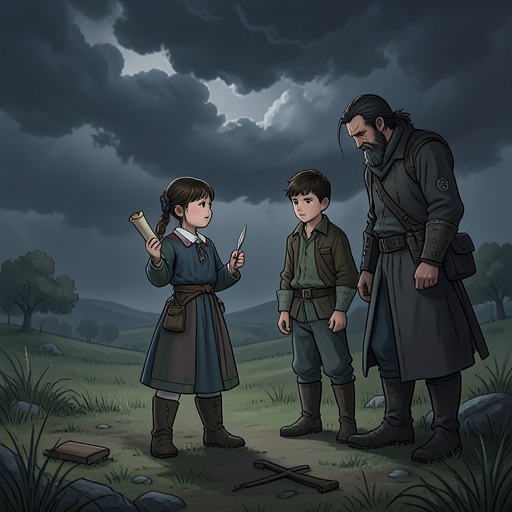
Aslan explains that an aged king in Narnia is grieving because he has no heir. The king’s only son was stolen years earlier, and no one knows where the prince went or whether he is alive. Aslan tells Jill that the prince is alive and commands her to seek him until she finds him and brings him to his father, dies in the attempt, or returns to her own world. The signs therefore serve a specific rescue and restoration: the missing prince is not merely a traveler to be discovered but the king’s son and the future heir whose absence has left the succession unresolved.
The first sign concerns Eustace Scrubb’s arrival in Narnia. As soon as he sets foot there, he will meet an old and dear friend; he must greet that friend immediately, and doing so will bring the pair good help. The instruction ties the beginning of the search to a timely act of recognition: the meeting itself is not enough if Eustace fails to respond to it as directed.
The second sign sends the travelers north, out of Narnia, to the ruined city of the ancient giants. The third depends on what they find there: an inscription on a stone must be obeyed. The fourth identifies the lost prince through a distinctive request. If Jill and Eustace encounter him, he will be the first person in their travels to ask them to do something in Aslan’s name. Together the signs combine geography, written instruction, and recognition through a spoken appeal; they offer different kinds of evidence, but all require the travelers to remember what Aslan said.
Remembering and Interpreting
When Jill replies that she understands, Aslan warns that she may not understand as well as she thinks. He makes her repeat the four signs in order. Her first attempt is imperfect, so he corrects her and has her repeat them again until she can recite them accurately. His patience makes memorization part of the assignment rather than a preliminary formality: the signs will have to guide the children when Aslan is no longer giving them clear instructions in person.
Before sending Jill from the mountain, Aslan emphasizes that she must recall the signs morning and night, and when she wakes during the night. Whatever strange events follow, she is not to let them turn her mind away from the instructions. He also warns that he will not often speak so clearly to her in Narnia. The mountain’s clear air and Jill’s clear mind will give way to confusion as she descends, and the signs will not look as she expects when she encounters them. Their meaning must therefore be held firmly enough to survive a misleading appearance.
This warning sets up a recurring tension between a sign and the circumstances in which it is read. The instructions are explicit, but recognition is not automatic: the travelers must compare what they experience with what they were told instead of allowing immediate comfort, fatigue, or the apparent strangeness of a situation to decide what is true. The signs offer guidance, not an exemption from judgment; their force in the story depends on whether the travelers keep attending to them.
Distraction and Missed Signs
On the difficult journey north, the travelers endure narrow valleys, a harsh wind, stony ground, and the lack of firewood or sheltered places to camp. At the same time, the prospect of staying at Harfang takes over the children’s thoughts. They dwell on beds, baths, hot meals, and being indoors, and stop talking about Aslan or the missing prince. Jill gives up repeating the signs morning and night, first blaming tiredness and then forgetting the habit altogether. Rather than cheering the travelers, anticipation of comfort makes them more self-pitying and irritable with one another and with Puddleglum.
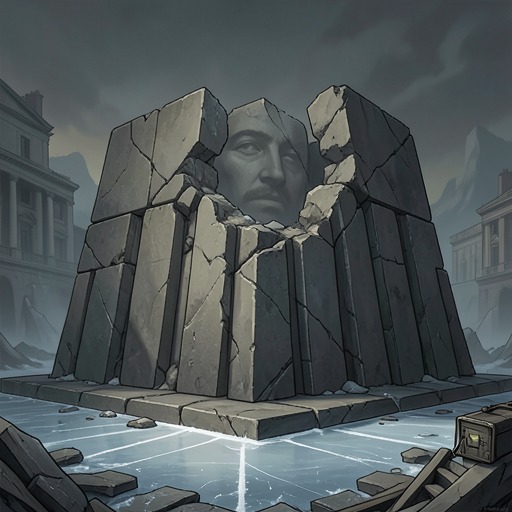
The failure becomes plain when the travelers see the ruined city from the castle. In daylight, the hill they crossed is unmistakably the remains of a gigantic city: its broad summit is still paved, its banks are the remnants of enormous buildings, and the apparent cliff and chimneys are parts of giant architecture. Across the pavement, in large dark letters, is the inscription “UNDER ME.” The city and its writing were the second and third signs, but the travelers had passed through them without recognizing what they were seeing.
Eustace calls the signs missed, and Jill recognizes how her lapse contributed. She says that if she had continued thinking about the signs, she might have recognized the city even under snow. Puddleglum admits that he had noticed the resemblance, or nearly noticed it, but did not act on his suspicion. The episode gives the earlier warning about appearances a concrete consequence: the city did not cease to be the sign when snow concealed its character; the travelers’ attention failed to connect the landscape to what they had been told.
The Fourth Sign and Its Test
The fourth sign arrives in a situation that appears to argue against trusting it. A prisoner, bound in a chair, pleads to be released and invokes Aslan’s name. The travelers had promised one another not to set the Knight free, and Puddleglum initially treats the appeal as cunning. Yet the words make all three recognize the sign: Eustace identifies them more cautiously as the words of the sign, while Jill asks what they should do.
Their uncertainty is not simply whether they remember the instruction. They understand that the prisoner’s request matches it, but fear that the match could be a trap: perhaps the Queen of the Underworld knows the signs and has taught him to use Aslan’s name. At the same time, they know they have already missed three signs and cannot dismiss the fourth merely because following it is frightening. The moment brings memory, suspicion, and the cost of earlier inattention into direct conflict. The signs’ decisive function is not only to point toward the prince, but to demand action when the travelers cannot make the meaning entirely comfortable or certain.